Lebanon’s Cumulative Trade Deficit Up by 10% YoY to $8.65B by June 2026
According to the Lebanese Customs Administration, Lebanon’s cumulative trade deficit increased by 10% year-over-year (YoY), to reach $8.65B by June 2026. This change was driven by a cumulative 5.6% YoY ($539 million) increase in imports by June 2026 and a 14.15% YoY ($247 million) decline in exports during the same period.
The widening of Lebanon’s trade deficit by June 2026 can be largely attributed to the repercussions of the renewed escalation of the Israeli-Hezbollah conflict, which continued to and repeated weigh on business activity, production, and trade flows. Ongoing security uncertainty and repeated ceasefire breaches continued to disrupt economic activity and hinder export-oriented sectors, contributing to the decline in cumulative exports. Meanwhile, cumulative imports remained resilient, reflecting Lebanon’s continued reliance on imported goods to satisfy domestic demand and replace supplies disrupted by the conflict. On a monthly basis, imports increased by 20.15% in June, reaching $1.7B, while exports declined by 19.1% to $250M.
Lebanon’s Balance of Trade (USD Million)

YTD: Year to Date
Top Import Destinations for Lebanon (YTD up to June 2026)
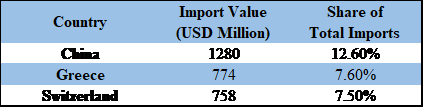
The top three import destinations by June 2026 were China, Greece, and Switzerland, accounting for 12.6%, 7.60%, and 7.50% of the total value of imports, respectively. The top imported products were mineral products (24.21%) at $2,457 million. Pearls, precious stones and metals (13.51%) at $1,371 million, and Products of the chemical or allied industries (9.86%) at $1,001 million.
Top Export Destinations for Lebanon (YTD up to June 2026)
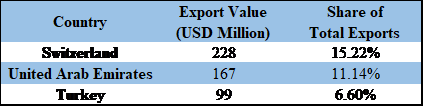
On the exports side, the top three destinations by June 2026 were Switzerland, United Arab Emirates, and Turkey, capturing respectively 15.22%, 11.14% and 6.6% of the total value of exports. The top exported products were Pearls, precious stones and metals (26.50%) at $397 million, Base metals and articles of base metals (17.16%) at $257 million, and Prepared foodstuffs, beverages, and tobacco (14.29%) at $214 million.
By Marybel Estephan