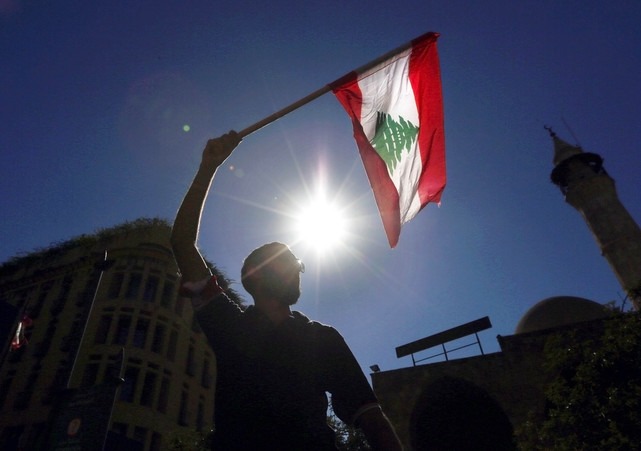
A right-wing Christian Phalange Party supporter waves a Lebanese flag during a protest near the parliament building in downtown Beirut, Lebanon, Thursday, Nov. 12, 2015. Supporters of the Phalange Party protested Thursday outside the parliament building demanding that the legislature elect a new president rather than draft new laws. (AP Photo/Bilal Hussein)
Lebanon’s Economic Outlook amid Political Uncertainty: Scenarios from the IIF
The Institute of International Finance (IIF), in its latest report on Lebanon, “Lebanon: Economic Outlook under Heightened and Divergent Political Pathways” (July 6, 2026),argues that Lebanon’s economic outlook has become increasingly dependent on the interaction between political developments, security conditions, and the government’s ability to implement meaningful reforms. Although the country had begun to achieve modest macroeconomic stabilization before the recent escalation in the Hezbollah-Israel conflict, renewed hostilities have significantly weakened economic prospects. As a result, the IIF projects that Lebanon’s real GDP will contract by approximately 12% in 2026, reflecting the sharp decline in tourism, reduced reconstruction-related inflows, and the continued absence of a credible policy framework. Despite these challenges, official foreign exchange reserves remain relatively stable at around $11.6 billion, while the exchange rate has remained close to LBP 89,700 per US dollar since August 2023, largely because of strict liquidity management rather than any fundamental improvement in economic conditions.
For the full report click HERE.