Lebanon’s Fiscal Performance in 2025: Economic Recovery Drives a Strong Fiscal Surplus
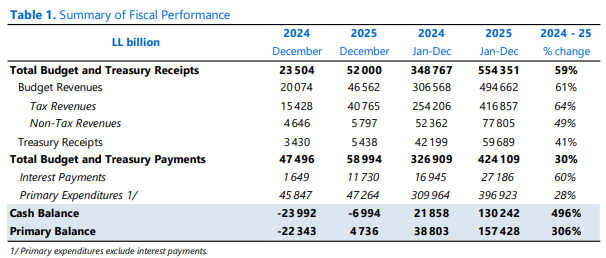
According to the Ministry of Finance (MoF) latest figures, Lebanon recorded a fiscal surplus (cash balance) of LL 130,242B by December 2025, up from a surplus of LL 21,858B recorded by December 2024. In detail, total budget and treasury receipts reached LL 554,351B by December 2025, while total budget and treasury payments stood at LL 424,109B. It is worth noting that the primary balance, which excludes interest payments, posted a surplus of LL 157,428B by December 2025. The strong fiscal outcome came during a year marked by improving economic conditions following the cessation of hostilities between Israel and Hezbollah in late November 2024 and the election of a President in January 2025, which helped restore confidence and support a gradual recovery in economic activity with a GDP growth rate of 3.8%
Source: Republic of Lebanon – Ministry of Finance
Fiscal revenues recorded LL 554,351B in 2025. Budget revenues reached LL 494,662B, accounting for 89.23% of total revenues, while treasury receipts amounted to LL 59,689B. Tax revenues, constituting 84.27% of budget revenues, stood at LL 416,857B by December 2025. The improvement in revenues coincided with a broad recovery across several sectors of the economy. Tourism activity increased significantly, with the number of incoming visitors rising by 44.59% year-on-year to 1,635,490 visitors, supported by improving travel conditions and renewed confidence. Similarly, cumulative airport passenger traffic rose by 24.70% year-on-year to 7,011,129 travelers, reflecting stronger arrivals and departures throughout the year as airline operations normalized compared to the severe disruptions witnessed during the conflict period. Meanwhile, private sector activity showed signs of recovery, with the BLOM Lebanon PMI remaining above the 50.0 threshold for five consecutive months by year-end and standing at 51.2 in December 2025, signaling sustained expansion in business activity and domestic demand. Together, these developments likely supported government revenue collection through stronger consumption, travel-related spending, and business activity.
In detail, revenues from domestic taxes on goods and services reached LL 227,237B, of which Value Added Tax (VAT) amounted to LL 179,249B. Taxes on income, profits and capital gains totaled LL 71,273B, while taxes on international trade reached LL 66,584B. Note that, Lebanon’s cumulative trade deficit widened by 22.84% year-on-year to $17.44B as imports increased by 24.70% to $21.08B, outpacing the 34.43% rise in exports. But, the increase in imports likely contributed to stronger customs and trade-related tax revenues during the year. As for non-tax revenues, they recorded LL 77,805B by December 2025, out of which income from public institutions and government properties reached LL 58,122B, supported mainly by telecom revenues of LL 33,514B.
On the expenditures’ side, total budget and treasury payments reached LL 424,109B by December 2025. Current expenditures accounted for the largest share at LL 320,517B, followed by capital expenditures of LL 30,481B, budget advances of LL 33,848B, customs administration expenditures of LL 5,425B, and treasury expenditures of LL 33,837B. Meanwhile, total interest payments reached LL 27,186B, comprising LL 14,701B in domestic interest payments and LL 12,485B in foreign interest payments. In detail, personnel costs remained the largest component of current expenditures, amounting to LL 231,066B, while various transfers reached LL 36,898B. Capital expenditures increased significantly to LL 30,481B, supported by construction in progress, maintenance spending, and CDR foreign-financed projects. The rise in capital spending is notable as it coincided with a broader improvement in economic and institutional conditions during 2025, reflecting efforts to support public services, infrastructure-related activity, and reconstruction needs following the disruptions experienced during the preceding period.
Overall, Lebanon’s fiscal performance improved markedly in 2025, supported by stronger revenue collection amid recovering economic activity, tourism, and private sector demand. While regional uncertainties and external imbalances continue to pose challenges, the sizeable fiscal and primary surpluses highlight the positive impact of improved confidence and a more stable environment throughout much of the year.
Nevertheless, the sustainability of this improvement remains uncertain, as the renewed escalation between Israel and Hezbollah in early March 2026 is expected to weigh on economic activity and public finances, potentially making the strong fiscal surplus recorded in 2025 short-lived.