Lebanon’s Inflation Rate increased by 17.26% YOY in March 2026
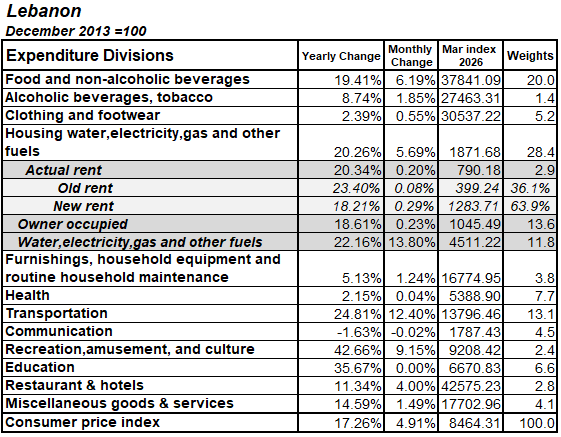
Lebanon’s annual inflation rate rose by 17.26% year‑on‑year (YOY) in March 2026, accelerating from 12.27% YOY in February 2026 (a 4.91% monthly rise) and 14.19% in March 2025, according to the Central Administration of Statistics (CAS). This was the highest annual inflation rise recorded since December 2024.
A mix of shocks drove this surge. The US‑Israeli‑Iranian war, which erupted on 28 February, disrupted global supply chains. The closure of the Strait of Hormuz forced importers to rely on longer, costlier shipping routes, sharply raising product prices. Energy costs spiked worldwide, feeding into transport expenses and rippling across the economy, since energy is embedded in nearly all production processes and consumer goods. Food inflation was particularly hit hard, as natural gas is a critical input for fertilizer production.
Domestically, Lebanon faced additional pressures. The re‑escalation of the Hezbollah‑Israeli war disrupted production by damaging factories and farmland, while Israeli strikes on bridges and roads disrupted transport routes, driving prices higher. The war also damaged many homes and forced large numbers of people to relocate to safer areas, driving up housing demand and costs. In February 2026, the government imposed a LBP 300,000 hike on gasoline, compounding the external energy shock. It also introduced new container fees, further inflating the cost of imported goods. These measures’ effect was only partially visible in February’s figures, since they were implemented halfway through the month.
Since some Lebanese areas were heavily damaged by the war, CAS faced significant challenges in collecting the prices of goods and services. Therefore, it seeked some alternative methods, such as imputation, replacement and reliance on electronically available data, and adopting prices from points of sale shared with areas less affected by the aggression. CAS still succeeded in issuing the CPI in a scientifically sound manner.
Here is a breakdown of the March 2026 CPI:
Figure 1: Lebanon’s March 2026 Inflation Breakdown
Sources: CAS, BLOMINVEST
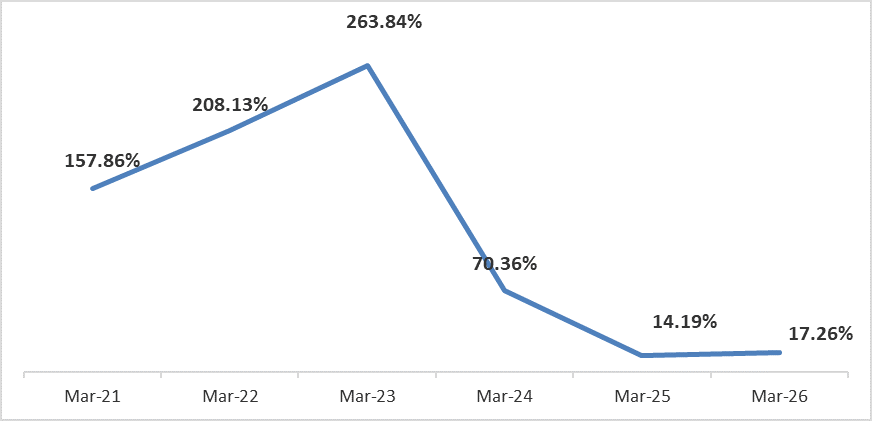
While the CPI has accelerated compared to last year, and remains high relative to regional benchmarks, it is still well below the levels recorded before 2025. This moderation reflects increased dollarization of the economy and the stabilization of the exchange rate at around 89,500 LBP per USD. If the war in Lebanon does not end within the coming months, there are growing concerns that exchange rate stabilization could be disrupted, leading to sharp increases in inflation across the country.
Figure 2: Lebanon’s Inflation Trends (2021-2026)
Sources: CAS, BLOMINVEST
Disclaimer:
This article is a research document that is owned and published by BLOMINVEST Bank SAL.
No material from this publication may be modified, copied, reproduced, repackaged, republished, circulated, transmitted or redistributed directly or indirectly, in whole or in any part, without the prior written authorization of BLOMINVEST Bank SAL.
The information and opinions contained in this document have been compiled from or arrived at in good faith from sources deemed reliable. Neither BLOMINVEST Bank SAL, nor any of its subsidiaries or affiliates or parent company will make any representation or warranty to the accuracy or completeness of the information contained herein.
Neither the information nor any opinion expressed in this research article constitutes an offer or a recommendation to buy or sell any assets or securities, or to provide investment advice.
This research article is prepared for general circulation and is circulated for general information only.